
Your First Pup Event Will Probably Feel Weird
And honestly, that’s probably a good sign.
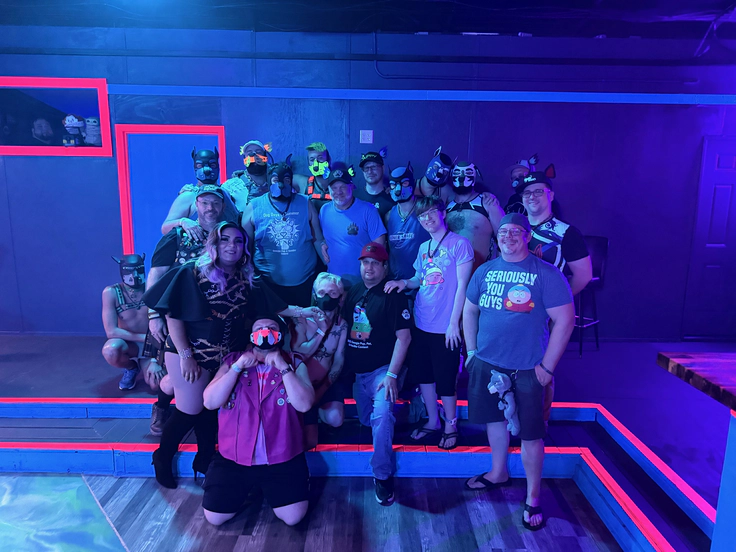 Most of us did not arrive confident. We arrived curious.
My first pup event happened before most people were even calling it pup play the way we do now.
It was during International Mr. Leather 2005 in Chicago, back when the community was much smaller, much less visible, and honestly a lot less defined than it is today. There were no giant Telegram chats, no endless social media explainers about headspace, and no massive vendor marts full of custom gear in every possible color. Most of us were figuring things out as we went.
I had volunteered to help set up and tear down the pup mosh, which at the time was still a relatively new part of the weekend. Looking back now, it is funny how small and community-built it all felt compared to modern pup spaces. The mosh was not some giant polished institution yet. It felt experimental in the best possible way. A group of people carving out space for something they knew mattered even if the larger leather community was still trying to understand exactly what it was becoming.
Honestly, volunteering probably helped me survive socially.
Having something to do gave me an anchor while everything else around me felt unfamiliar. I remember hauling mats, helping organize the room, trying to stay busy while internally overanalyzing absolutely everything. At the same time, I was fascinated by what I was seeing around me. People barking, wrestling, roughhousing, laughing, collapsing into piles on the mats. There was an openness and playfulness to it that felt very different from the more structured leather spaces I had experienced before.
And underneath all of that fascination, I was deeply self-conscious.
I kept looking around convinced everyone else understood something I had somehow missed. I wondered whether I was supposed to act differently, sound differently, move differently. I worried that I looked awkward or out of place. At the time, everyone around me seemed impossibly confident, like they had already unlocked some secret version of themselves that I had not figured out yet.
Then at one point, a guy dressed like a postal worker walked into the mosh carrying boxes addressed to the pups.
And the entire room absolutely lost its mind.
Pups swarmed him immediately, barking and tumbling over each other trying to tear into the packages while people laughed from the edges of the mats. Inside the boxes were toys and gifts for the pups, including a bunch of SquarePeg toys. The whole thing was chaotic, playful, ridiculous, and weirdly wholesome all at the same time.
I remember standing there watching this unfold and realizing something important:
Nobody in that room was worried about looking cool.
That sounds simple, but honestly it hit me hard.
The people around me were allowing themselves to play openly and unapologetically in a way I do not think I had fully seen before. Not performative. Not polished. Just genuinely playful. Joyful. Present with each other in the moment.
And I think that was part of why the space felt so emotionally different from other environments I had experienced.
During that weekend, I met members of the Phoenix Boys of Leather, and honestly, they completely changed the way I understood pup play.
Up until then, I think I had mostly understood it from the outside. I saw the gear, the barking, the crawling, the obvious visual pieces people notice first. But they helped me understand that pup play was not really about pretending to be a dog in the simplistic way many newcomers first assume. What they described instead was something much more emotional and much more human.
They explained headspace to me in a way that finally clicked.
A lot of newcomers hear the word “headspace” and imagine some kind of instant transformation. They think they are supposed to put on a hood and suddenly become perfectly instinctual, carefree, and disconnected from the rest of the world. Then they arrive at an event still thinking about work stress, social anxiety, whether they parked legally, and if they look ridiculous standing in the corner, and they assume they are somehow failing.
But headspace usually is not that dramatic.
For a lot of people, it is quieter than that. Softer. More gradual.
It is the feeling of your brain finally becoming less loud for a little while. The constant self-monitoring starts to loosen. You stop worrying so much about performing adulthood correctly. Play, movement, touch, barking, physicality, gear, wrestling, affection, or simple social connection interrupt the nonstop noise most of us carry around every day.
For some people, that feels energetic and chaotic. For others, it feels deeply calming. Sometimes it feels euphoric. Sometimes it simply feels like relief.
And honestly, many people do not fully experience headspace during their first event because they are too nervous trying to figure out whether they belong there in the first place. That is normal too.
I think that was one of the most important things I learned during that weekend. Nobody was grading me on how well I performed being a pup. There was no invisible checklist I needed to complete before I was allowed to belong in those spaces. The people around me were not performing perfect characters. They were allowing themselves access to parts of themselves that ordinary adult life often suppresses: joy, affection, curiosity, vulnerability, physicality, emotional honesty, and play.
That vulnerability is part of why first pup events can feel so strange.
You are stepping into a room full of people allowing themselves to be unusually open with one another. Even if you have spent time in kink spaces before, pup spaces often carry a very different emotional energy. There is chaos and silliness, sure, but there is also softness underneath it. Connection. Trust. The quiet relief of not having to constantly hold yourself together in the same rigid way you do everywhere else.
I think newcomers often expect belonging to arrive all at once in some giant transformative moment. More often, it happens slowly through smaller interactions. A conversation while setting up mats. Someone complimenting your gear. A laugh that feels genuine instead of forced. A pup asking your name. Realizing you stopped monitoring yourself for thirty seconds because you were simply enjoying being there.
That is usually how community starts.
Not through perfection, but through repetition.
Over time, you stop feeling like someone observing the room and start feeling like someone participating in it.
And honestly, most of us are still figuring ourselves out years later. The confident social pup bouncing between friend groups may still feel anxious before events. The title holder teaching classes may still remember what it felt like to stand awkwardly near a wall hoping someone would talk to them. The loud chaos goblin wrestling in the middle of the mosh may still occasionally wonder whether they are too much.
Nobody arrives fully formed.
We become ourselves gradually.
I also think newcomers put enormous pressure on themselves to “do pup play correctly.” People worry about gear, barking, dynamics, labels, body types, or whether they are somehow “pup enough.” But one of the most important things I learned from that first weekend at IML was that there is no single correct way to be a pup.
Some pups are loud. Some are quiet. Some are deeply playful. Some are affectionate. Some dive immediately into the center of the mosh while others quietly observe from the edges for months before feeling comfortable enough to engage. All of those experiences are real. All of them count.
Looking back now, I think that weekend mattered so much because it quietly gave me permission to stop treating joy like something I had to earn first.
At the time, I did not have the language for any of it yet. I did not fully understand headspace. I did not understand how important community would eventually become in my life. I definitely did not understand that more than twenty years later I would still be teaching, writing about, and helping other people navigate these same feelings.
I just knew something inside me felt lighter there.
Not because I suddenly transformed into a perfectly confident pup overnight, but because for the first time I saw people allowing themselves to play openly without apology. They were affectionate. Ridiculous. Vulnerable. Chaotic. Soft. Human. And nobody seemed interested in punishing them for it.
That changes something in you when you experience it for the first time.
Especially if you have spent most of your life carefully monitoring yourself, trying to appear composed, controlled, mature, or “normal” enough for everyone around you.
I think that is why first pup events can feel so emotionally overwhelming for newcomers. On the surface, it may just look like barking, gear, wrestling, and chaos. But underneath all of that, many people are experiencing something much quieter and much more important:
Relief.
Relief that maybe they are not the only person who feels this way. Relief that maybe they do not have to perform adulthood every second of the day. Relief that maybe there are spaces where playfulness, vulnerability, affection, and softness are not weaknesses to hide.
And if your first pup event feels weird, awkward, emotional, overstimulating, exciting, confusing, or even a little terrifying sometimes?
Good.
That probably means you are experiencing it honestly.
Because almost nobody walks into these spaces already knowing exactly who they are.
Most of us become ourselves a little at a time.