
The Responsibility of Visibility
Protecting the spaces that allowed us to become ourselves.
 Visibility means more than being recognized. It means helping protect the spaces that made us possible.
The first time someone recognizes you in a queer space because of something you wrote, taught, or shared online, it feels strange in the best possible way. For a moment, it is easy to experience it purely as excitement. Someone waves across the bar. Someone introduces themselves at an event. Someone tells you they read one of my posts before attending their first pup night because it made everything feel less intimidating.
Over time, though, I have started to realize those moments carry a different kind of weight too. Visibility is not just about being noticed. It is about understanding that people pay attention to how you move through a community once they begin seeing you as part of it.
Over the past year, that realization has changed the way I think about leadership within the pup community. I do not think leadership is really about popularity, authority, or even titles on their own. I think it is about stewardship. It is about helping protect the spaces, cultures, and relationships that allowed many of us to become ourselves in the first place.
I think about that a lot when I move between spaces now.
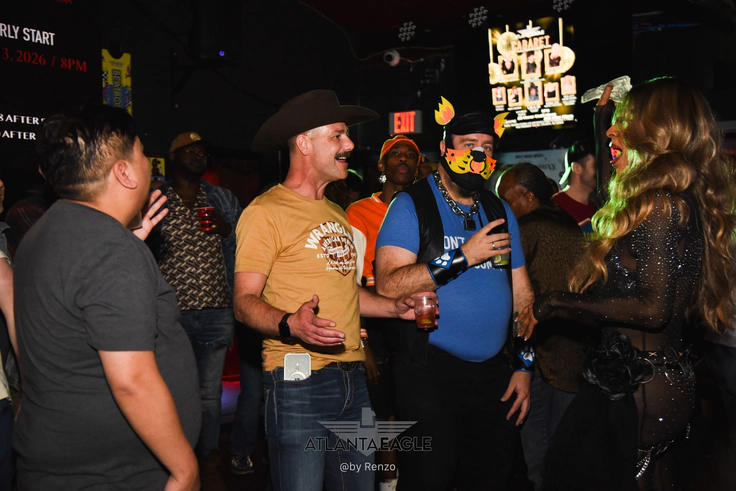
At Pup Night at The Heretic in Atlanta, I have watched nervous first-timers slowly settle into themselves over the course of a single evening once someone simply says hello and makes room for them in conversation. At Eagle Atlanta, I have seen generations of leather culture existing side by side in ways that remind me these communities survive because people before us protected them long enough for us to inherit them.
In London, I have felt that same sense of continuity at Collared at Central Station Public House, standing in a room filled with pups from across the world who all somehow found their way to the same basement bar under the Heathrow flight path. I have felt it at Comptons in Soho, where queer history practically hums through the walls, and at the Duke of Wellington, where drag queens, pups, leather folk, and tourists somehow all coexist in beautiful chaos.
I have felt it dancing at Beefmince events at both the Royal Vauxhall Tavern and The Steel Yard, surrounded by thousands of people celebrating queer joy openly and unapologetically. I have felt it at Furry Weekend Atlanta while helping run Moonlight and watching over seven thousand attendees create a temporary world together inside a convention space that only existed because hundreds of volunteers chose to care enough to build it.
And I have especially felt it during quieter moments.
A nervous pup asking me questions after a class at Spring Training.
Someone recognizing Ruff from across a crowded convention hallway and stopping me just to say one of my blog posts helped them feel less alone.
A first-time attendee lingering near the edge of a room until someone finally invited them into the circle.
None of those moments are dramatic on their own. But together they have taught me something important: communities are not sustained by visibility alone. They survive because people actively choose to care for them.
That responsibility shows up in ways that are often very unremarkable from the outside. It looks like helping maintain a strong culture of consent instead of assuming someone else will handle it. It looks like making newcomers feel welcomed without making them feel overwhelmed or pressured. It looks like checking in on the person standing quietly near the edge of the room because you remember exactly what it felt like to be them once. Sometimes it looks as simple as volunteering, helping clean up, teaching a class, or contributing to a space because communities only survive when people actively care for them.
Lately, I have been thinking a lot about another side of that responsibility too: protecting queer spaces by respecting the boundaries that keep them open and safe.
I completely understand why younger people are curious about pup culture and kink communities. I honestly wish I had found parts of this community much earlier in my own life. These spaces gave me friendship, confidence, emotional healing, and a version of myself I thought I had lost for a long time. Wanting connection is human. Wanting belonging is human too.
But part of caring about a community means understanding that preserving spaces sometimes requires limits, structure, and accountability. Queer bars, leather spaces, and kink venues already operate under constant scrutiny socially, politically, and legally. They survive because owners, staff, volunteers, and community members work hard to protect them. If those boundaries are ignored, these spaces can lose licenses, lose venues, or disappear entirely.
I have had conversations recently with current titleholders and community leaders about the importance of protecting these spaces responsibly, especially as pup visibility continues growing online. The answer cannot simply be “everyone should have access to everything immediately.” Sustainable communities require stewardship. They require respecting the rules that allow these spaces to continue existing at all.
That is why I do not see protecting those boundaries as exclusionary. I see it as an act of care.
The older I get, the more I believe healthy communities are built not just through visibility, but through collective responsibility. Visibility without accountability can easily become ego. Visibility paired with care becomes leadership.
That distinction matters deeply to me because this community changed my life. It gave me a place to rediscover joy, playfulness, vulnerability, and connection after years of feeling disconnected from myself. It gave me friendships across cities and countries. It gave me opportunities to teach, create, volunteer, and grow. Most importantly, it gave me the freedom to fully become Ruff instead of treating him like a temporary escape from the rest of my life.
So when I talk about being #UnapologeticallyPuppy, I am not talking about doing whatever you want without consequences. To me, it means showing up authentically while also recognizing that authenticity and responsibility should grow together. The more visible we become, the more intentional we should be about the example we set for the people entering these spaces after us.
Because ultimately, the goal is not just to enjoy these communities ourselves.
It is to help make sure they still exist for the next nervous puppy walking through the door.