
The Pieces We Leave Behind
Alaska, tiny corgis, old family stories, and the connections that stay with us.
 Some stories aren't meant to stay with us. They're meant to continue.
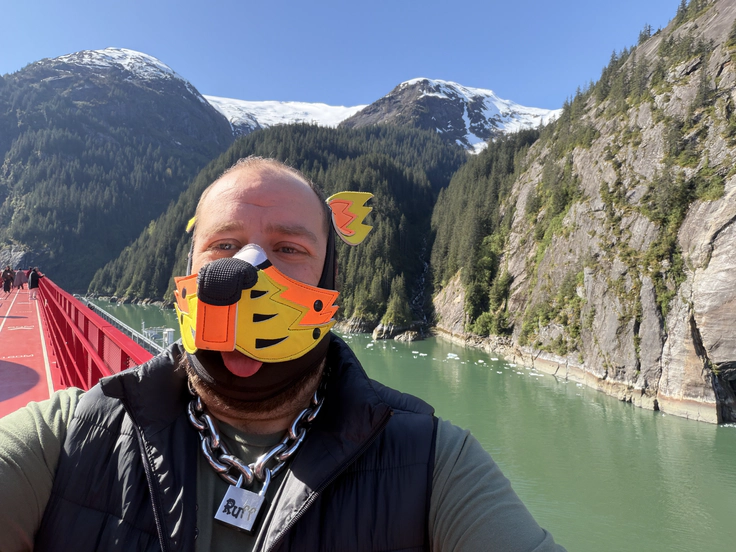
Standing on the deck of a ship surrounded by mountains that seem too large to be real, it’s hard not to feel small. Not insignificant. Just small in the way that reminds you the world is much bigger than whatever has been occupying your thoughts lately.
Alaska has a way of doing that.
The glaciers don’t care about your plans. The whales don’t care about your worries. The mountains aren’t impressed by your accomplishments and they aren’t interested in your anxieties. They simply exist, stretching across the horizon with a scale that is difficult to describe until you’ve seen it for yourself. I took hundreds of photographs during the voyage and I’m glad I did, but every time I look at them I’m reminded of how impossible Alaska is to capture. The mountains look smaller in pictures. The glaciers seem closer. The feeling disappears somewhere between your eyes and the camera lens. Alaska is one of those places that has to be experienced because so much of what makes it extraordinary isn’t what you see. It’s what you feel standing in front of it.
Part of that feeling was deeply personal.
Long before I was born, my uncle moved to Alaska to work as an engineer for an oil company. Family stories say he loved it here. When I was born, he rushed to Palm Springs to meet me and brought me a stuffed bear. I still have that bear today. Not long after, he died in a helicopter crash.
I don’t remember him. Everything I know about him comes from stories told by other people, old photographs, and memories that don’t really belong to me. Growing up, Alaska wasn’t just a state on a map. It was the place my uncle had loved. The place where he had built a life. The place where his story ended. For most of my life it existed more as family mythology than reality.
Walking through Alaska changed that.
As we sailed through Glacier Bay and along the coastline, I found myself wondering what he had seen when he looked at these mountains. What made him stay. What made him fall in love with a place so different from anywhere else. I never found answers to those questions, but by the end of the trip I realized I didn’t really need them. Sometimes understanding isn’t about collecting facts. Sometimes it’s about standing in the same place, looking at the same horizon, and feeling a small piece of what someone else must have felt. Somewhere between the glaciers and the open water, I stopped thinking about Alaska as the place where my uncle died and started thinking about it as the place he loved.
That shift surprised me.
For years, Alaska had always been connected to loss. This trip allowed me to connect it to something else. Wonder. Adventure. Curiosity. Joy. I found myself understanding how someone could look out across these landscapes and feel called to stay. There is a wildness to Alaska that feels increasingly rare. It reminds you that the world is still bigger than the boxes we build around our lives.
The trip also made me realize how much my own life has changed over the last few years.
The first time I sailed with Virgin Voyages, I was still married. Looking back, I realize how much of that voyage was spent trying to determine what I was allowed to do. My ex preferred spending a lot of time in the cabin, and I spent a surprising amount of energy wondering whether it was okay for me to have a different experience. Was it okay to go ashore without him? Was it rude to spend an afternoon exploring on my own? Should I stay because he wanted to stay? At the time those questions felt normal. Looking back now, they feel heartbreaking in a way I didn’t fully appreciate then. I wasn’t just navigating a vacation. I was navigating permission.
This trip was entirely different.
For the first time, there was nobody else’s schedule to manage and nobody else’s expectations to navigate. If I wanted to spend an hour watching whales from the top deck, I did. If I wanted to wander through town with my camera, I did. If I wanted to sit quietly and stare at mountains, I did. And if I wanted to put on my pup hood, take photos as Ruff in front of glaciers, and create memories that would have felt impossible a few years ago, I did that too.
What struck me wasn’t the freedom to do those things. It was how natural it felt.
There was a time when I would have worried about what strangers thought. A time when I would have felt self-conscious about being visible. A time when I might have talked myself out of taking the photo, wearing the hood, or embracing the moment because it seemed easier to blend in. Somewhere along the way, that changed.
One of the greatest gifts the pup community has given me isn’t a hood, a collar, or a title. It’s the confidence to participate in my own life. To stop standing on the sidelines waiting for permission. To stop assuming that joy requires justification. To simply show up as myself and trust that the people who matter will understand.
That lesson showed up repeatedly throughout the voyage.
One of the unexpected joys of the trip was how naturally community appeared. Over the years I’ve learned that queer people have an uncanny ability to find one another almost anywhere, and apparently that includes the waters off the coast of Alaska. I spent time with a group of bears who welcomed me immediately. I met fellow furries in The Manor. I made friends from Austin and from places much farther away. None of those encounters were planned. None of them appeared on the itinerary. They happened because I was present, visible, and willing to engage with the world around me.
A younger version of me would have missed much of that. Not because the opportunities weren’t there, but because I wouldn’t have put myself in a position to experience them. One of the things I’ve come to appreciate most over the last few years is that community rarely arrives fully formed. More often than not, it begins with a conversation, a shared laugh, a compliment, a question, or simply the willingness to say hello.
Before the cruise, I packed a handful of small 3D-printed Ruff figurines. At first, it was just a silly idea. I’d hide them around the ship and maybe make a few people smile if they happened to stumble across one. Like most of my favorite ideas, it wasn’t particularly practical and didn’t serve any larger purpose. It just sounded fun.
As the voyage went on, though, I found myself becoming oddly attached to the project.
One of my favorite placements ended up in the Future Voyages area. There was a display case filled with ship memorabilia and models, and somehow a tiny Ruff found his way inside. What I loved about that one wasn’t that people would see it. In fact, most people probably won’t notice it at all. What I loved was the idea that he might stay there. Protected behind glass, safe from accidentally disappearing into someone’s suitcase, he could continue sailing long after I had gone home. Future passengers would pass by him on cruises to places I’ve never been and may never see. He might cross oceans I never cross and visit ports I never visit. There’s something strangely comforting about that idea.
A few days later, I came across a Facebook post from someone who had found one of the figurines elsewhere on the ship. They were delighted by it. Not because it was valuable or because it served any purpose beyond existing, but because it was unexpected. It had brightened their day. Reading that brought me far more joy than I expected. I had left a tiny piece of myself somewhere on a ship in Alaska and, entirely by accident, it had made someone smile.
The older I get, the more I think that’s true of people as well.
For a long time I thought relationships were measured primarily by duration. The people who mattered most were the people who stayed. Friendships that lasted decades seemed more meaningful than friendships that lasted months. Relationships that ended felt somehow lesser because they had ended. But the last few years have challenged that way of thinking. Travel has a way of introducing you to people who matter enormously despite occupying only a small chapter of your life. Some of my favorite memories are attached to people I knew for a weekend, an evening, or a single conversation. They arrived unexpectedly, left something behind, and continued on their journey.
As I thought about that tiny corgi sitting in a display case somewhere aboard a cruise ship, I realized that’s part of what I enjoy about leaving them behind. Once they’re placed, their story no longer belongs entirely to me. They become part of someone else’s experience. Maybe they’re discovered immediately. Maybe they sit unnoticed for weeks. Maybe they make someone laugh. Maybe they become a photo on social media. Maybe they disappear and are never seen again. I don’t get to control any of that.
In some ways, that’s how every meaningful connection works.
We move through one another’s lives carrying pieces of ourselves, and occasionally we leave one behind. Sometimes it’s a memory. Sometimes it’s encouragement. Sometimes it’s a story that gets retold years later. Sometimes it’s simply the knowledge that, for a brief moment, someone understood you.
My uncle left me a bear.
Decades later, it still sits on a shelf.
This week I left a few tiny corgis on a cruise ship.
Maybe they’ll disappear tomorrow. Maybe they’ll travel farther than I ever will. Maybe years from now someone will find one tucked into a corner and smile.
We rarely get to know where the things we leave behind will end up.
Standing in Alaska, thinking about a man I never really knew and a bear I’ve carried with me my entire life, I realized that’s probably okay.
Some stories aren’t meant to stay with us.
They’re meant to continue.