
The Dog Who Taught Me How to Be a Better Puppy
Sometimes the best lessons about authenticity come from someone who never had to question who they were.
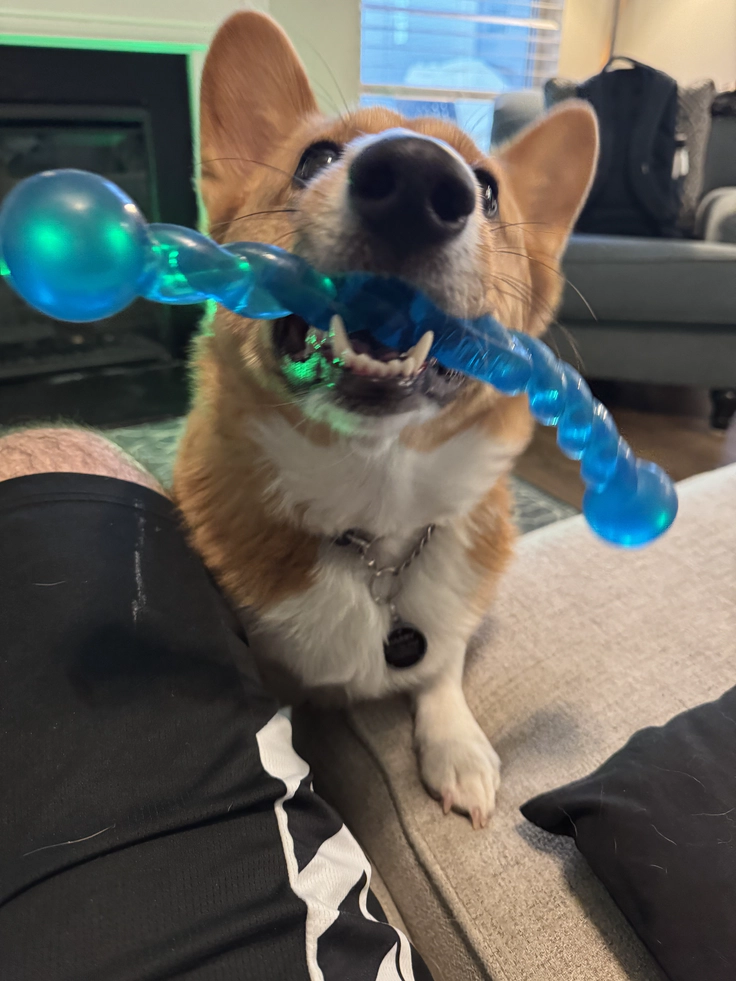 Dogs never forget how to be themselves. Maybe that's what we've been trying to rediscover all along.
Harry has absolutely no respect for my work calendar.
It doesn’t matter whether I’m answering emails, writing a blog post, or sitting on an important conference call with my camera on. If Harry decides it’s time to play fetch, then, in Harry’s mind, it is objectively time to play fetch.
Like most dogs, he’ll bring me one of his toys and patiently wait for me to throw it. The patience, however, only lasts for so long. Somewhere along the way, Harry taught himself a new strategy. If I don’t immediately acknowledge his invitation, he simply picks up the toy and throws it at me. Not near me. At me. More than once I’ve had a tennis ball bounce off my shoulder while I’m trying to sound professional on a video call, or watched a stuffed animal land squarely in my lap as coworkers tried very hard not to laugh. To Harry, there is no conflict between work and play. There is only the very obvious fact that I seem to have become distracted from something much more important.
Eventually, I give in. I throw the toy once, fully intending for it to be just a quick break before returning to whatever I was doing. Harry, of course, has very different plans. He tears after it with the same enthusiasm he has shown every single day of his life, proudly brings it back, squeaks it a few times for emphasis, and waits for the next throw. Then another. And another. Before long, he’s panting so hard that he collapses into a dramatic corgi sploot in the middle of the floor, completely exhausted and completely satisfied with the afternoon’s accomplishments.
I’ve watched this routine play out hundreds—probably thousands—of times. The toy changes. Sometimes it’s a tennis ball. Sometimes it’s a squeaky fox that’s seen better days. Sometimes it’s whatever object Harry has decided counts as a toy in that particular moment. The game itself, though, never changes. Every throw is treated like the greatest throw in the history of fetch. Every return is delivered with the same eager expectation that surely this next throw will be every bit as exciting as the last one.
It never seems to occur to Harry that we’ve done this before.
There is no boredom in repetition. There is no thought that perhaps he should be doing something more productive. There is no concern that someone might think he’s too old to get this excited over a fuzzy tennis ball. The thousandth game of fetch carries exactly the same possibility of joy as the first.
Watching him over the years has made me realize that Harry experiences the world in a way most adults slowly forget. He doesn’t wonder whether now is the right time to be excited. He doesn’t worry about looking ridiculous while sprinting after the exact same ball for the fiftieth time. He doesn’t stop to consider whether he’s earned a break or whether someone else might judge how enthusiastically he greets the people he loves. If something brings him joy, he embraces it completely and without hesitation.
For the longest time, I thought Harry was simply teaching me to take more breaks during the workday. Looking back now, I think he was teaching me something much bigger than that.
He was reminding me how to play.
Somewhere between childhood and adulthood, many of us quietly stop giving ourselves permission to do things simply because they make us happy. We begin measuring our time by productivity instead of presence. We exercise because it’s healthy, not because running feels good. We schedule dinners weeks in advance because life is busy. Even our hobbies begin needing a purpose. They should teach us something, improve us somehow, or produce something tangible that justifies the time we spend on them.
The strange part is that nobody ever tells us this directly. It simply becomes the culture we grow up in. Responsibilities accumulate. Careers become more demanding. Calendars become fuller. Little by little, play transforms from something woven naturally into life into something we’re expected to earn after everything else is finished.
The problem, of course, is that everything else is never finished.
There is always another email to answer, another project to complete, another errand that could be crossed off the list. Harry has never understood any of that. He has never looked at me working and thought, “I’ll come back later.” In Harry’s world, life is happening now. Fetch is now. Joy is now. As ridiculous as it sounds, there are days when I need that reminder far more than I care to admit.
The more I watch Harry, the more I notice another lesson quietly hiding beneath all that enthusiasm.
Harry has never wondered whether he’s being a good dog.
He has never compared himself to another corgi and worried that his bark sounds wrong or that he doesn’t fetch enthusiastically enough. He’s never looked at another dog and decided he ought to wag his tail differently or greet visitors with a little less excitement. He doesn’t second-guess whether he sploots correctly. He simply wakes up every morning and goes about the important business of being Harry.
Oddly enough, I think that’s one of the biggest lessons he’s taught me about puppy play.
Over the years I’ve met countless people who quietly ask the same question in different ways. Sometimes it’s after one of my classes. Sometimes it’s during Pup Tea. Sometimes it’s a message that arrives after someone has read one of these blog posts. The wording changes, but the question underneath rarely does.
“I don’t bark.”
“I don’t really crawl.”
“I don’t like wearing a hood.”
“I’m more cuddly than playful.”
“I don’t feel like the other pups.”
Every one of those questions is really asking the same thing.
“Do I belong?”
I understand those questions because I asked many of them myself. When I first discovered puppy play more than twenty years ago, I spent an awful lot of time assuming everyone else had figured something out that I hadn’t. They seemed so comfortable. So confident. They knew where to stand, how to interact, what gear meant, and all of the little unspoken customs that somehow felt obvious to everyone except me. I became convinced there must be a correct way to be a puppy and that everyone else had received the instruction manual before I arrived.
Now, after two decades, I can honestly say I don’t think that manual exists.
One of the reasons I’ve often compared puppy play to punk has very little to do with aesthetics and everything to do with philosophy. Punk has always resisted the idea that authenticity can be standardized. The moment someone decides there is only one correct way to be punk, they’ve missed the point entirely.
I think puppy play works much the same way.
Yes, there are traditions worth preserving. There are skills worth learning. There are safety practices that matter deeply. There are mentors whose experience deserves respect. Education matters. Stewardship matters. Looking after one another matters.
None of those things, however, create a single “correct” puppy.
Some pups bark constantly. Others barely bark at all. Some spend all night wrestling. Others would much rather curl up beside someone they trust. Some wear hoods every chance they get. Others almost never do. Some are energetic chaos. Others are quiet comfort. The diversity isn’t a flaw in puppy play. It’s one of its greatest strengths.
Harry has never spent a single day trying to become someone else’s dog.
Maybe we spend far too much time trying to become someone else’s puppy.
Travel has given me another lesson from Harry that I didn’t fully appreciate until recently.
Because of my job, conventions, teaching, and trips to London, I’m away from home far more than most people. Thankfully, Harry has an incredible support system. My parents absolutely adore him, and the feeling is completely mutual. Whenever I’m traveling, Harry gets his own vacation. He has grandparents who spoil him rotten, take him on walks, sneak him treats they probably shouldn’t, and happily let him become the center of attention.
There are times when I joke that he probably doesn’t even notice I’m gone.
Then I come home.
The moment Harry realizes I’m walking through the front door, every day apart seems to disappear. His whole body starts wagging before his tail can keep up. He races circles around the house, bouncing between me and the nearest toy because, naturally, the proper way to celebrate someone’s return is with a game of fetch.
My favorite part isn’t the excitement, though.
It’s what happens a few hours later.
Once the toys have been abandoned across the living room and the zoomies have finally subsided, Harry climbs into bed beside me without being asked. He turns around three or four times—because apparently every dog signed the same agreement about bedtime rituals—then presses himself against my side, lets out one impossibly deep sigh, and falls asleep.
Those moments have become some of my favorite moments in the world.
Not because Harry needs me.
He doesn’t.
He’s perfectly capable of spending a wonderful week with my parents. He’s loved, cared for, entertained, and spoiled while I’m away.
That’s exactly what makes coming home so meaningful.
When I walk through the front door, Harry chooses me all over again.
Watching that has taught me something I think humans struggle with far more than dogs do.
Dogs don’t keep score.
Harry has never greeted me with resentment because I was away too long. He has never demanded an explanation for why work took me across the country or why I spent another week overseas. He doesn’t replay the days I was gone. He doesn’t make me earn my way back into his good graces.
He’s simply happy that, right now, we’re together again.
I sometimes wonder how different our relationships would feel if we became a little more like that. We carry yesterday into today. We replay old conversations. We keep mental scorecards without even realizing we’re doing it. We worry about tomorrow while missing the people sitting right beside us.
Harry doesn’t.
He lives exactly where his paws are.
If we’re playing fetch, that’s his whole world. If we’re walking around the neighborhood, there’s nowhere else he’d rather be. If we’re lying in bed after I’ve been gone for a week, nothing else matters because his favorite person is finally home.
For all the books I’ve read, all the classes I’ve attended, all the mentors I’ve been fortunate enough to learn from, and all the experiences puppy play has given me over the last twenty years, one of my greatest teachers has been a fifty-pound corgi with terrible meeting etiquette and an unwavering belief that joy never needs permission.
People sometimes ask me where Ruff came from.
They expect a story about discovering puppy play, buying my first hood, or finding my place in Leather. Those moments absolutely mattered. Puppy play gave me a language for parts of myself I hadn’t yet understood, and it introduced me to friendships, mentors, and experiences that changed my life forever.
But when I look back now, I realize that long before I ever put on a hood, there was already a little corgi quietly teaching me the values I would one day find again through puppy play. He taught me that joy doesn’t need to be earned. That authenticity isn’t something you perform. That love doesn’t keep score. That being fully present is a gift you can give yourself and the people around you.
Maybe that’s why being a puppy has never felt like pretending to be a dog.
Maybe it’s always been about remembering the parts of ourselves that dogs never forgot.