
Confessions of a Chaos Corgi
Maybe the product owner plans the trip so the puppy can enjoy the adventure.
 Maybe Chaos Corgi was never the problem.
One of the things I’ve come to appreciate about friendship is that, eventually, your friends begin to notice things about you that you never notice about yourself.
It starts innocently enough. Someone points out that you always order the same thing at a restaurant, or that you’re somehow always the first person awake on a trip. Over time, those little observations become inside jokes, and those inside jokes become part of your identity within the group. They’re not malicious. Quite the opposite. They’re the kind of affectionate teasing that only happens when people know you well enough to laugh with you instead of at you.
For years, I’ve proudly referred to myself as a Chaos Corgi. It seemed like the perfect description. I get excited easily, I chase interesting opportunities without much hesitation, and if someone I care about says, “Hey, come look at this,” there’s a very good chance I’ll abandon whatever I was doing to go see it. I always assumed the “chaos” referred to that enthusiasm—the puppy brain that constantly finds something new and exciting.
It turns out my friends had a different definition.
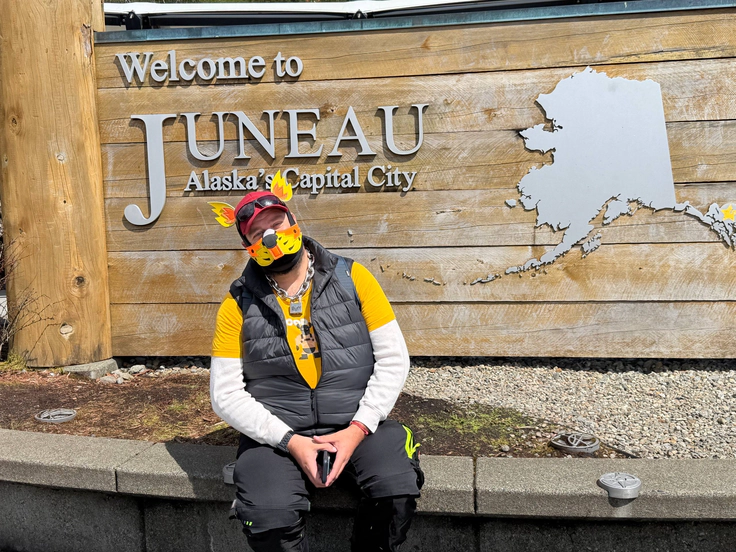
Earlier this summer, I had the chance to take an Alaska cruise with a wonderful group of friends. One of my favorite parts of traveling with people you genuinely enjoy is that the destination almost becomes secondary. The memories rarely come from the things you planned months in advance. They come from wandering through little shops, laughing at ridiculous souvenirs, stopping for coffee because someone spotted an interesting café, or discovering something unexpected simply because you weren’t in a hurry.
Our stop in Juneau was exactly that kind of day. We spent the afternoon wandering through downtown, drifting from one small business to another with no real agenda beyond seeing what caught our attention. Somewhere along the way, however, a pattern began to emerge. More than once I came just a little too close to a display while turning around to answer a question. A rack of postcards wobbled. A shelf full of souvenirs rattled enough to make everyone collectively inhale. Nothing fell. Nothing broke. But after the third or fourth near miss, I noticed my friends had started paying just a little more attention whenever I walked into a shop.
I maintained they were overreacting.
They maintained they were simply managing risk.
Then we found the pottery shop.
It was a charming little lesbian-owned shop filled with handcrafted ceramics. Every shelf seemed to hold another piece that had clearly taken hours to create: colorful mugs, hand-thrown bowls, delicate sculptures, and glazed pottery that looked like they belonged in someone’s carefully curated home rather than within arm’s reach of an enthusiastic six-foot-five corgi.
Without thinking much about it, I headed toward the entrance.
I didn’t make it very far.
Nitro stepped in front of me, glanced toward the shelves of fragile pottery, looked back at me, and simply said, “No.”
I laughed because I assumed he was joking.
He wasn’t.
After watching me narrowly avoid several retail incidents throughout the afternoon, he’d apparently decided this was where he drew the line. This wasn’t the place to discover whether my streak of “almost knocking things over” would finally become “actually knocking things over.” I wanted to point out that I hadn’t broken a single thing all day, but I had a feeling that wasn’t the compelling defense I imagined it to be.
The funniest part was that I wasn’t even wearing a tail.
For years I’ve happily blamed my tail for the occasional bumped chair or unexpected collision. It’s a wonderfully convenient scapegoat. Tails wag, they swing, and they occasionally occupy space you forgot existed. Nitro had apparently reached the conclusion that the tail had been unfairly accused.
The real hazard was standing on two feet.
So while everyone else wandered through the pottery shop admiring the craftsmanship, I remained outside. I found a spot by the front window where I could still see everyone browsing, occasionally holding up a mug or pointing excitedly at something they had found. Looking back, I imagine I looked like a puppy patiently waiting outside a bakery while everyone else enjoyed the treats inside.
As if the moment needed one final flourish, the shop cat wandered over and settled onto the windowsill directly opposite me. We stared at each other through the glass for several seconds. I’d love to tell you there was a moment of mutual understanding, but if I’m honest, it felt much more like I was being evaluated. The cat seemed completely convinced that Nitro had made the correct decision.
The entire situation was ridiculous, which is precisely why it was so funny. Nitro wasn’t trying to exclude me, and I certainly wasn’t offended. If anything, we were both laughing because the joke had become too perfect. An afternoon of near misses had somehow culminated in me being politely denied entry to a pottery shop for the safety of the pottery. It’s still one of my favorite memories from the trip, not because I got “banned” from a pottery shop, but because it perfectly captured the kind of affection that develops when people know your quirks well enough to turn them into stories.
At the time, I assumed it would simply become another funny memory we’d retell whenever someone mentioned Alaska.
I had no idea it was only the first piece of evidence.
A few nights later, we were all gathered around the dinner table on the ship, talking about the day’s adventures. Like most dinners on that cruise, the conversation wandered naturally from one topic to another. Someone was talking about an excursion, someone else was showing off something they’d bought ashore, and another conversation had already splintered off down the other end of the table. That’s one of my favorite parts of traveling with friends. The meals are rarely just about eating. They’re about telling stories, laughing at each other, and somehow ending up on topics that have absolutely nothing to do with how the conversation started.
Somewhere in the middle of all of that, Nitro looked across the table at me with a grin.
“You know what your favorite place is?”
I looked up from my dinner.
“What?”
“In the way.”
There was a moment where everyone around the table started smiling, and that’s when I realized I was the only one who didn’t know where this conversation was going.
“I am not always in the way,” I protested, convinced this accusation was wildly exaggerated.
Before I could offer a single piece of evidence in my defense, Torch looked up from across the table.
“He’s right.”
There wasn’t even the slightest pause. No consideration of my argument. No attempt to play devil’s advocate. Just immediate agreement, delivered with the confidence of someone pointing out an obvious fact.
I looked around the table, hoping someone might take my side.
No one did.
Instead, I was met with a collection of knowing smiles that all seemed to say the same thing:
We’ve all noticed this.
What struck me wasn’t that Nitro had made the joke. It was that everyone else immediately recognized it. Somewhere along the way, without my knowledge, my friends had collectively concluded that my natural habitat wasn’t the observation deck, the buffet, or even the hot tub.
It was “in the way.”
Once I stopped trying to defend myself and started paying attention, I realized they had a point. I really do have an uncanny ability to occupy exactly the amount of space someone else needs. Put me in a crowded elevator with a backpack on and there’s a decent chance I’ll turn at exactly the wrong moment and either bump into someone or accidentally press three extra buttons with my backpack. (My apologies to everyone who shared an elevator with me at Furry Weekend Atlanta.) Hand me a rolling case on the London Underground and I’ll somehow stop just long enough for someone to have to awkwardly step around me. If there’s one cabinet someone wants to open, I’ll inevitably be standing in front of it while finishing a conversation. None of it is intentional. In fact, I’m usually blissfully unaware that I’m doing it until someone politely says, “Excuse me, Ruff.”
The older I’ve gotten, the more I’ve realized that my mental picture of myself and the physical reality don’t always line up. In my head, I apparently still move through the world like someone who takes up very little space. Reality, however, insists on reminding me that I’m six-foot-five, usually carrying at least one bag, and occasionally gesturing enthusiastically while telling a story. Somewhere between those two versions of myself is the reason Nitro confidently declared that my favorite place is “in the way.”
The more I thought about it over the next day or two, the more I realized this wasn’t really about hallways or pottery shops. My friends weren’t making fun of me. They were reflecting something back to me that I couldn’t see on my own. The people who know us best have a remarkable ability to notice the little patterns we never recognize in ourselves, and sometimes those observations become the stories that define a friendship.
Not long after the cruise, Kuma and I were lying in bed one evening talking before we went to sleep. I don’t remember exactly how we got onto the subject, but at some point I referred to myself as a Chaos Corgi. He smiled in that familiar way he does when he’s about to disagree with me without making it feel like an argument and said, “I don’t actually think you’re chaotic. I think you’re one of the most structured people I know.”
After that conversation, I found myself thinking about it for days.
Not because I was trying to prove Kuma wrong, but because I couldn’t stop asking myself a simple question.
If he’s right, then where did Chaos Corgi come from?
The easy answer would be that one of us is wrong, but I don’t actually think that’s true. The more I sat with it, the more I realized we weren’t describing different people at all. We were simply describing different parts of the same person.
When people see Ruff at an event, they don’t see the hours that happened before I walked through the door. They don’t see the class outline that I’ve rewritten three times because one section didn’t quite flow the way I wanted it to. They don’t see the packing list, the itinerary, or me double-checking that I’ve remembered everything before I leave the hotel. They don’t see me updating the Ruff Beacon before a trip, or making sure I’ve packed the right gear instead of simply throwing things into a suitcase and hoping for the best.
They see the version of me who finally gets to stop being responsible for everyone else’s experience.
They see the puppy who gets excited because someone yelled, “Ruff!” from across the room. They see me disappear into a conversation, volunteer to help with something unexpected, or wander off because someone mentioned an interesting shop or an idea for a future class. They see the enthusiasm. They see the curiosity.
They see Chaos Corgi.
Kuma sees everything before that.
He sees the travel plans come together weeks before a trip. He sees me refining a class after I’ve already taught it because I thought of a better way to explain something. He’s watched me sit with difficult emotions until I’ve examined them from every possible angle, trying to understand not just what I’m feeling, but why I’m feeling it. He’s also watched me learn what it means to be in a long-distance poly relationship, noticing that whenever I find myself in unfamiliar emotional territory, my instinct isn’t to run from it—it’s to understand it.
I don’t think that’s because I need to control everything.
I think it’s because understanding has always helped me feel safe.
Looking back, I don’t think that started with my career, even if product management certainly reinforced it. Long before I was building roadmaps and thinking about dependencies, I was learning to cope with uncertainty by creating structure wherever I could find it. During the final years of my marriage, there were so many things I couldn’t control that I poured my energy into the things I could. Calendars. Plans. Routines. Organization. If life was going to be unpredictable, at least I could make sure I knew what happened next.
The funny thing is, I don’t think Ruff ever rejected that part of me.
I think he just gave it permission to rest for a while.
For years I’ve thought of Ruff as the opposite of my professional life, but maybe that’s never been true. Maybe the product owner plans the trip so the puppy can enjoy the adventure. Maybe all of the preparation, organization, and structure simply create the freedom for Chaos Corgi to exist once I get there.
Maybe they were never opposites at all.
Maybe they’ve been taking care of each other this whole time.
That also made me think differently about the pattern Kuma had noticed after our visits.
He wasn’t pointing it out because he thought something was wrong with us. If anything, he was reminding me that there wasn’t.
I was the one trying to solve every goodbye before it happened.
Every trip felt different to me because every trip was different. We had different experiences, different conversations, different challenges, and different memories. But my response to leaving was almost always the same. Somewhere during those last couple of days, my brain would quietly start trying to answer questions that didn’t have answers yet. I’d start wondering how things were going, replaying conversations, looking for reassurance, and trying to understand feelings that were probably better experienced than analyzed.
The next time we see each other will probably be the biggest test of that pattern yet. I’ll fly to London on my own, we’ll fly back to Atlanta together, spend time here, then I’ll fly back to London with him before turning around and boarding a flight home to Atlanta alone. I already know my brain is going to want to get a head start. It’ll start asking questions before we’ve even said goodbye because that’s what it’s always done.
But recognizing a pattern changes something.
Patterns aren’t destiny.
For the first time, I can see it happening before I’m in the middle of it. I know where my mind will want to go, and maybe that’s enough to choose something different. Not because I expect the goodbye to be easy, or because I’ve suddenly stopped overthinking, but because I finally understand what my brain has been trying to do all this time.
It wasn’t trying to ruin the ending of every trip.
It was trying to protect me from it.
Maybe this time I’ll thank it for trying.
And then I’ll board the flight anyway.
I’ll probably still stand in the way. I’ll probably still bump the elevator buttons. And Nitro still probably shouldn’t let me into pottery shops.
But maybe Chaos Corgi was never the problem. Maybe he was simply the part of me that finally felt safe enough to take up space.