
A Chip in My Hand: Biohacking, Curiosity, and the Joy of Being Unforgettable
There’s a moment that happens sometimes when I meet someone new. It usually starts the same way. We’re talking, maybe at a bar or at an event, and eventually someone asks the normal question: “How do I find you?” Most people expect the usual response. A phone comes out, someone types in a username, maybe a QR code gets pulled up. Instead, I hold out my hand and say, “Scan it.”
They laugh the first time because they assume I’m joking. Then they tap their phone to the side of my hand, right where the chip sits under the skin. Their phone buzzes, a link opens, and suddenly the expression on their face changes from amusement to genuine confusion. Almost every time they look back and forth between their phone and my hand and say some version of the same thing: “Holy shit.”
That moment never really gets old.
What they’ve just scanned is one of two NFC implants that live in my hands. The first is an NXP ICODE SLIX2 chip, and the second is a MIFARE Ultralight. In practical terms, they’re tiny passive NFC tags embedded under the skin. They don’t have batteries, they don’t broadcast anything on their own, and they certainly aren’t tracking me. They only wake up when a phone or NFC reader comes close enough to power them through a radio field. When that happens, the chip briefly activates and sends whatever information I’ve stored on it, which is usually a link to something Ruff related like my website or contact page.
The interaction is simple from a technological standpoint, but the experience for people encountering it for the first time still feels a little like magic.
People often ask why someone would do this in the first place. The easy answer is that it’s fun, which is honestly part of the truth. But underneath that there’s something deeper that resonates with me. Biohacking, at least the way I think about it, isn’t about turning yourself into a futuristic cyborg. It’s really about curiosity and agency. It’s about asking what happens when technology stops being something we hold and starts being something that’s simply part of us.
For me the implants represent that intersection. They blur the line between identity and interface in a way that feels playful rather than intimidating.
The thing I’ve noticed over time is that the chips aren’t really about the technology at all. They’re about connection. When someone scans my hand, it creates a moment that sticks with them. It interrupts the normal flow of interaction just enough that the conversation becomes memorable. There’s a tiny sense of surprise, a little bit of delight, and sometimes a short conversation about how it works or why I decided to do it.
That small moment of curiosity turns a routine exchange of contact information into something people actually remember. And if there’s one thing I enjoy, it’s creating experiences that linger in someone’s mind after the moment has passed.
One of my favorite examples of this happened recently at the Eagle in Atlanta. I was talking with a couple visiting from Buffalo and eventually the conversation turned to the usual question of how to stay in touch. Instead of reaching for my phone, I told them to scan my hand. They assumed I was joking right up until their phone opened my site.
They kept glancing back and forth between the screen and my hand like they were trying to solve a puzzle. Finally one of them asked, completely baffled, why anyone would put a chip in their hand. I laughed and told him the honest answer.
Because you’re never going to forget me now.
He paused for a moment and admitted that I was probably right.
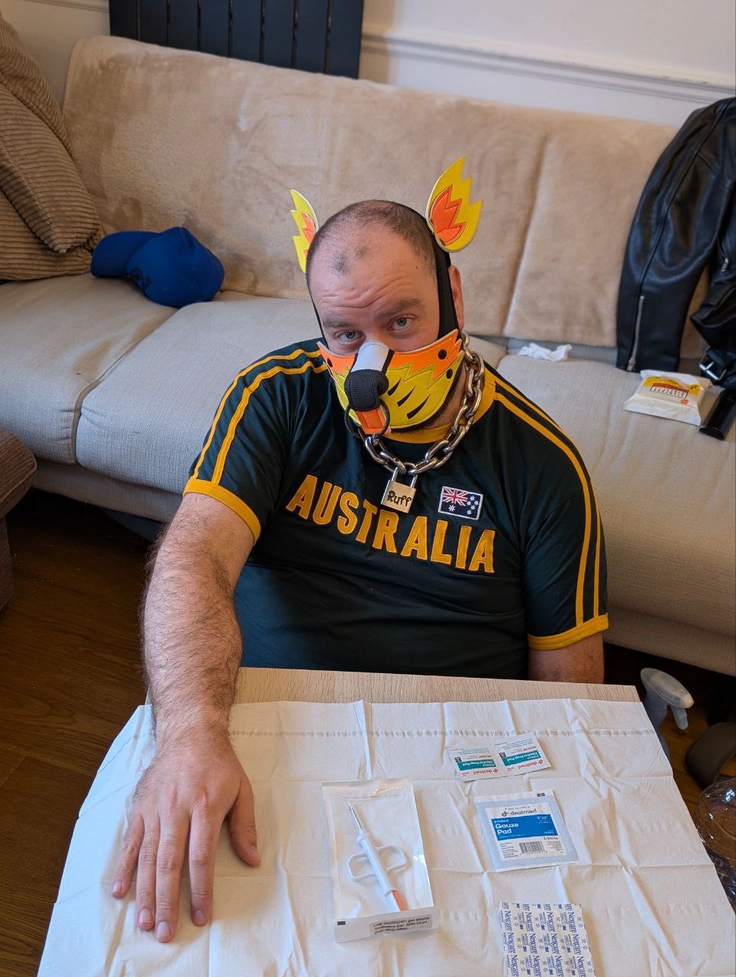
Another thing people often assume is that implants must involve some complicated medical procedure. In reality the process can be surprisingly simple when done with the right equipment and care. In my case, the moment was also far more personal than people expect. My Alpha installed the chips for me in his living room.
It wasn’t dramatic or clinical. It was quiet, deliberate, and strangely intimate. The injector used for implants like these is sterile and designed specifically for this purpose, and the whole process takes only a moment. There’s a brief pressure as the chip slides under the skin, and then it’s done.
What stayed with me afterward wasn’t the quick sting of the insertion but the meaning of the moment itself. It was an act of trust. My body was literally being modified in the presence of someone I care deeply about, someone who understands both the curiosity and the symbolism behind the choice.
That moment connected the technology to something much more human. Biohacking often gets framed as futuristic or cold, but the reality is that choices about our bodies are always deeply personal. The chips in my hands aren’t just gadgets. They’re part of my story and part of the relationships that shaped the version of myself I’m still becoming.
In some ways the implants have also become part of the larger identity I’ve built as Ruff. That identity has always been about curiosity, visibility, and leaning into experiences that blur boundaries between different worlds. Ruff is playful, a little chaotic, and deeply interested in connection. Having technology literally embedded in my hands fits that energy almost perfectly.
It turns the body itself into part of the interaction.
Most of the time I forget the implants are even there. They disappear into the background of daily life until someone taps their phone to my hand and their screen suddenly lights up. Then the conversation starts all over again. People ask questions. They want to know how it works. Sometimes they want to scan it again just to make sure it wasn’t a trick.
What excites me most about the implants isn’t what they do now, but the possibilities they hint at. Right now my chips mostly link to things like my website, my contact information, or specific pages depending on where I am. But I’ve started imagining how those interactions could become more playful and context driven.
Someone tapping my hand at an event in London might land on a page that says:
“You met Ruff at Collared 🐾
Here’s your moment.”
The same gesture in Atlanta might open something entirely different, a small digital breadcrumb tied to a particular night or gathering.
The technology itself is simple, but the storytelling possibilities around it feel surprisingly rich.
In the end, the implants aren’t about becoming more machine. They aren’t about efficiency or optimization in the way biohacking is sometimes portrayed. For me they’re about curiosity, playfulness, and the joy of creating memorable interactions in unexpected ways.
They turn a handshake into a conversation starter and a routine exchange of information into a story someone will probably tell later.
And if that moment of surprise also means people remember meeting Ruff long after the night ends, well, that’s just an added bonus.